Camay Lee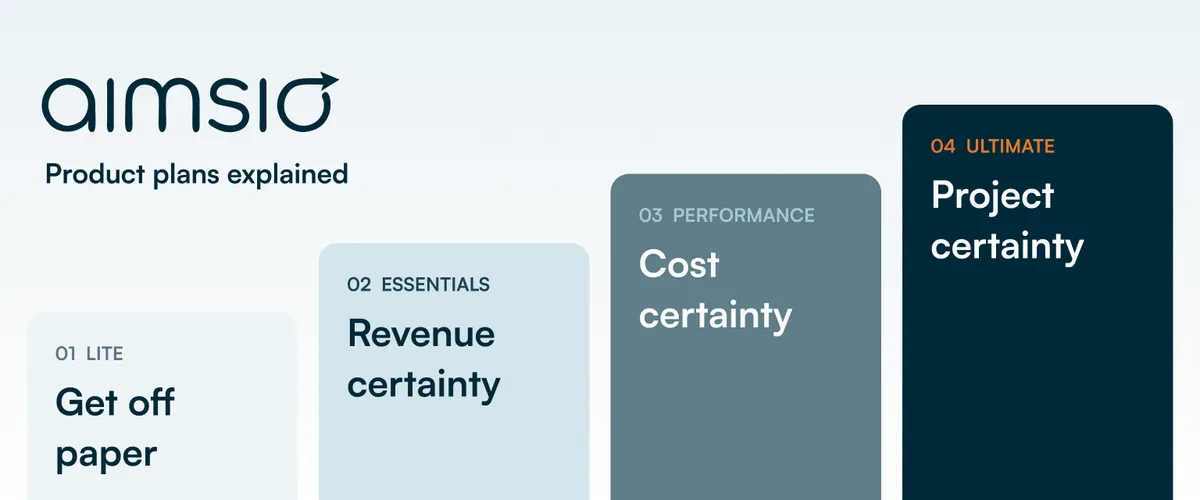
Most field companies evaluating software hit the same wall: it’s hard to get a straight answer on which version they actually need. You get a demo, a feature list, and a quote. What you don’t get is a clear explanation of why one plan costs more than another, or what you’re really buying when you move up a level.
Aimsio is priced around four plans: Lite, Essentials, Performance, and Ultimate. The difference between them isn’t just a longer feature list. It’s a different business outcome. Each plan is built to solve a specific problem, and the features inside it are what deliver that outcome. This post walks through what each plan is actually for, so you can figure out where your operation fits before you talk to sales.
You Pay for Outcomes, Not Seats
First, what you don’t pay for: users. Every Aimsio plan includes unlimited users. Ten people or two hundred, it doesn’t matter. Staff up for a big project and stand back down after, and your price doesn’t move. That’s a deliberate departure from the per-user pricing that quietly penalizes growth in a lot of field software, a trap we cover in detail in Is Your Field Management Software Eating Your Profits?
With seats off the table, the plans are organized around something more useful: outcomes. Think of them as a staircase, where each step up adds a new layer of certainty about your business.
Lite gets you off paper. Essentials gives you revenue certainty. Performance gives you cost certainty. Ultimate gives you project certainty.
Each plan includes everything in the plan below it. So moving up a step isn’t re-buying what you already have. It’s adding the next outcome on top of what you’re already running. That single fact is what makes upgrading low-risk, and it’s worth keeping in mind as you read on.
Tier 1: Lite
Get Off Paper
The problem Lite solves is the most common one in field operations: work still runs on paper. Handwritten tickets get lost in trucks, dropped in the mud, or pile up on a desk waiting to be keyed in. Lite exists to make that stop.
At this plan you get digital Tickets and Invoicing, Jobs to organize the work, a Client Portal for electronic sign-off, unlimited Price Books, and Access Management to control who sees what. In plain terms: the day-to-day paperwork of a field business, captured digitally instead of on paper.
What that gets you is capture without paper. The ability to record work, bill for it, and stop losing tickets between the field and the office. For a smaller company whose first goal is to digitize, that’s the whole job. And it’s the base every plan above builds on.
Tier 2: Essentials
Revenue Certainty
Getting off paper solves capture. Essentials solves whether the work you captured actually turns into revenue. This plan is built around making sure every hour and every billable makes it onto an invoice, closing the gap where money leaks out before it’s ever billed.
On top of everything in Lite, Essentials adds Timesheets, Tasks, T&M Estimates, and the one that matters most here, Timesheet Billing Automation. That last piece is the mechanism. Crew time captured in the field flows into your billing instead of sitting in a spreadsheet waiting for someone to transcribe it. The hours worked and the hours billed stop being two separate numbers that someone has to reconcile by hand.
The outcome is what we call revenue certainty: the confidence that completed work reliably becomes invoiced revenue, instead of getting lost to missed billables and manual re-entry. It’s a bigger idea than any one feature, and if you want the full framework, we’ve written about it in What Is Revenue Certainty? For most companies, Essentials is where “we’ve digitized” turns into “we’re capturing what we earn.”
Tier 3: Performance
Cost Certainty
Essentials tells you you’re billing everything. Performance tells you whether you’re making money on what you’re billing, while the job is still running instead of months after it closes.
This is Aimsio’s most popular plan, and it’s easy to see why. On top of everything in Essentials, it adds the capabilities that turn revenue visibility into cost visibility: Job Costing, Job Performance & WBS (budget and contract values, phase management, and cost and actual per WBS), Purchase Orders, and Timesheet Payroll Automation.
A company that can only see job profitability after a project closes can’t do anything about a cost overrun. By then the margin is already gone. Performance surfaces cost against budget at the job and phase level while work is still in progress, so you can course-correct in time. That’s cost certainty: knowing, in real time, whether a job is making or losing money.
If your operation has moved past “are we billing it all?” and is now asking “are we actually profitable on this job?”, Performance is the plan that answers it. Most companies get there sooner than they expect. The question of live margin usually arrives the first time a job closes lower than the bid promised.
Tier 4: Ultimate
Project Certainty
Ultimate is built for companies running large, complex, multi-phase projects, where the financial detail has to go deeper than job-level costing. If your work involves granular budgets, formal scope changes, and structured information requests, this is the plan that keeps all of it under control.
On top of everything in Performance, Ultimate adds Advanced Budgeting, Change Orders, and RFI. Advanced Budgeting lets you plan and track at a fine-grained level, not just “$25,000 budgeted for equipment,” but the breakdown across specific equipment classes within that. Change Orders and RFI formalize how scope changes and information requests get tracked and tied back to the work, which is exactly the control large projects live or die on.
The outcome is project certainty: keeping big, complicated jobs under control at a level of detail the plans below aren’t built to reach. If you’re bidding multi-phase work, carrying formal change-order processes, or answering to clients who expect a documented trail on every scope shift, Ultimate is where that lives.
Which Plan Fits Your Operation?
It’s less about company size, and more about the question you’re currently trying to answer.
| Your operation | The question you’re asking | The plan that answers it |
|---|---|---|
| Still on paper and spreadsheets | ”How do we stop losing tickets?” | Lite |
| Digitized, but billing leaks | ”Are we billing everything we’ve worked?” | Essentials |
| Billing cleanly, margins unclear | ”Are we profitable on this job right now?” | Performance |
| Running complex multi-phase projects | ”Can we control scope and budget at a granular level?” | Ultimate |
Most companies land in the Essentials-to-Performance range and grow into the next tier. Because each plan includes everything below it, you don’t have to get this perfectly right on day one. You can start where you are and move up as your needs grow, and moving up simply adds the next outcome rather than replacing what you have.
What Are You Really Paying For as You Move Up?
Yes, the price goes up as you move up a tier. But so does what you get back, and that’s the part worth looking at before you fixate on cost.
Start with the one thing that doesn’t change: you don’t pay by the head. Every plan includes unlimited users. So when you win a bigger contract and put more people in the field, or bring more of the office onto the platform, none of that grows your bill. The size of your crew and the size of your software bill have nothing to do with each other.
Each step up costs more because each step returns more. Essentials pays back in billables that used to leak out, untracked. Performance pays back the first time you catch a job going over budget while there’s still time to fix it, instead of finding out after the margin’s gone. Ultimate proves out on a single disputed change order that’s documented instead of eaten. You’re not paying for more features. You’re paying for a return that gets bigger as the questions get more expensive to answer wrong.
So the question to move up through isn’t “What does the next plan cost?” It’s “What is the outcome it unlocks worth to us right now?”
The full feature-by-feature comparison is on the product plans page. But the shape of the decision is the staircase: figure out which outcome you need, and the plan follows from there.
Where Your Operation Goes From Here
Most operations don’t stay on one step forever. The work gets bigger, the questions get sharper, and the plan grows with them. The useful thing to figure out isn’t just where you are today. It’s the next question you’ll need answered, because that’s the step you’ll be climbing to.
If you want help placing your operation on that staircase, a short conversation with someone who knows field ops will get you there faster than a quote ever could.
Frequently Asked Questions
How are Aimsio's plans structured?
Aimsio has four plans: Lite, Essentials, Performance, and Ultimate. Each one maps to a business outcome, not just a feature count: getting off paper, revenue certainty, cost certainty, and project certainty. Each plan includes everything in the plan below it, so moving up adds the next outcome on top of what you already have. All plans include unlimited users.
Which Aimsio plan is right for my company?
It comes down to the question you're trying to answer. If you're trying to get off paper, that's Lite. If you're trying to make sure everything you work gets billed, that's Essentials. If you need to see job-level margins while work is still in progress, that's Performance, which is where most growing field businesses land. If you're running complex, multi-phase projects that need advanced budgeting, change orders, and RFI, that's Ultimate. Because each plan builds on the one below, you can start where you are and move up as you grow.
Does the number of users affect my price?
No. Every Aimsio plan includes unlimited users, so your price doesn't change whether you add office staff or staff up a crew for a big project. This is a deliberate difference from per-user pricing models, which we cover in Is Your Field Management Software Eating Your Profits?
Can I change plans later?
Yes. You can upgrade or downgrade your plan at any time, with changes taking effect at the start of your next billing cycle. Because each plan includes everything in the plan below it, moving up simply adds capabilities rather than replacing your setup.
What happens to my software cost if we have a big year?
A big year usually means more people in the field and more work moving through the platform. Neither one changes your plan, because every Aimsio plan includes unlimited users, so growth in your crew never grows your bill. If a bigger year pushes you toward the next plan, that's because you've grown into the outcome it delivers, not because you got billed for the busy season. If you expect real swings year to year, it's worth talking through which plan fits where your operation is heading.