Dennis Hale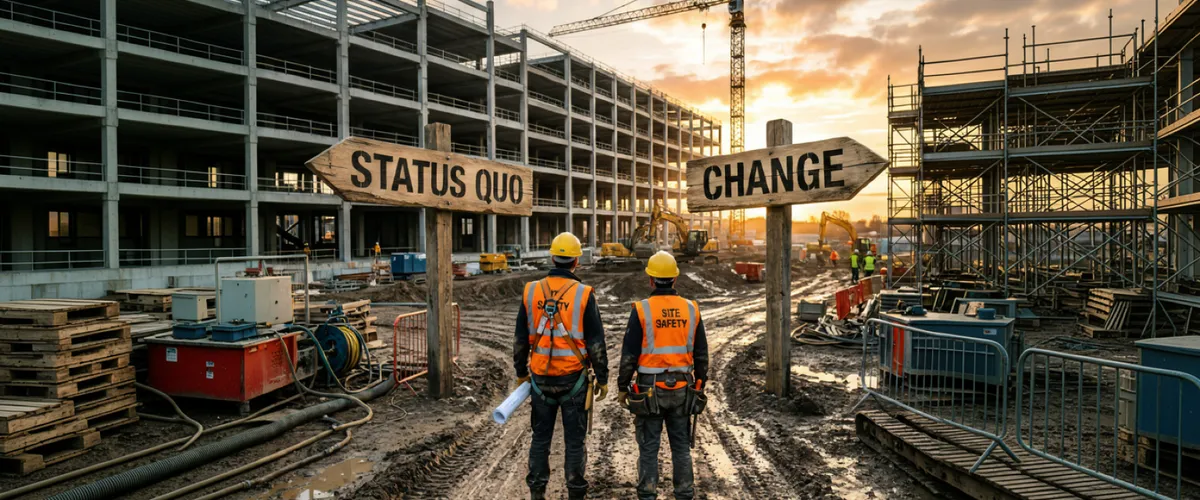
There is always someone benefiting from the status quo. Always.
This isn’t a theory. It’s a law of organizational physics. Field service companies such as those in oilfield, pipeline, and civil construction, have people whose comfort, authority, or job security depends on things staying exactly the way they are. They’re not bad people. They’re not saboteurs. They’re simply not incentivized to change, and in the absence of a forcing function, that’s enough to keep an entire operation stuck.
If you run a field service or construction business, you’ve seen this up close, even if you haven’t named it yet.
Why Do Field Operations Stay Broken?
Think about your own operation for a moment. Who benefits when things stay the way they are?
The field supervisor who controls the flow of information because that’s how they stay indispensable. If data moved through a system instead of through them, they’d lose the informal authority that comes from being the only one who knows what actually happened on site last Tuesday.
The office admin who has built a working empire of spreadsheets that only they can navigate. The complexity isn’t malicious. But it has made them effectively irreplaceable, and that complexity is now the process.
The ops manager who knows the current workflow is broken but also knows they won’t be held accountable for it. Fixing it means admitting it was broken. Leaving it means nothing changes. And nothing changing is comfortable.
None of these people are trying to hurt your business. But their comfort is costing you real, measurable money every single day. And because the cost never shows up as a line item, it’s easy to let it slide.
What Does the Status Quo Actually Cost?
This is where most companies underestimate the damage. The status quo tax doesn’t appear on your P&L. It lives in the gap between what you invoiced and what you should have invoiced. It hides in the week between job completion and the invoice going out. It sits in the truck that ran an extra day because nobody had visibility into whether the job was done.
Every ticket that doesn’t get captured. Every timesheet that gets rounded. Every invoice that goes out late because someone had to “check with so-and-so first.” That’s the tax you pay for protecting the status quo.
Field service companies running manual processes lose an estimated 3 to 5 percent of annual revenue to billing delays and approval bottlenecks. The average delay from work completion to invoice is 5 to 12 days. At scale, that’s not an inconvenience. It’s working capital you’re financing on behalf of your clients, with no interest, no plan, and no end in sight.
So why does it continue? Because the people who benefit from the status quo are counting on you not seeing it clearly enough to act.
Is This a Technology Problem or a Power-Structure Problem?
Mostly the second one. And that’s what most software vendors won’t tell you.
Most field service companies don’t lack data. They lack timely, trustworthy data that doesn’t have to flow through a person before it becomes useful. When you introduce a system that captures work directly, approves it in real time, and routes it straight to billing, you’re not just adding a tool. You’re redistributing how information moves. That shift makes some people uncomfortable, and that discomfort is often framed as a technology objection.
“Our crew won’t use it.” “We don’t have cell service.” “Our spreadsheets are working fine.”
These objections are worth taking seriously on their face. But they’re also worth interrogating. Crews use their phones for everything else. Offline capability is a solved problem. And spreadsheets that require three hours of reconciliation before an invoice can go out aren’t working fine, they’re working slowly at a cost you’ve just stopped noticing.
What Changes When You Remove the Status Quo?
The shift from manual, people-dependent field operations to a system of execution looks specific and concrete. It’s not about features. It’s about who controls the transaction, and when.
| Area | Status Quo (people-dependent) | Forward-Thinking Process (system of execution) |
|---|---|---|
| Data capture | Field supervisor remembers and reports later, often incomplete | Captured at the moment work happens, by the crew doing it |
| Approvals | Chased through email and phone calls, delayed by days | Routed automatically; exceptions escalated, routine approvals handled |
| Billing cycle | 5 to 12 days from work completion to invoice | Invoice goes out same day work is completed |
| Visibility | Owner finds out about overruns after the job closes | Project health visible in real time while there’s still time to act |
| Revenue leakage | 3 to 5% lost annually to manual process gaps | Every hour worked becomes an hour billed |
Swift Underground, an underground utility contractor in Western Canada, made this shift after years of Excel spreadsheets that couldn’t separate labor from equipment costs. Projects went over budget without anyone knowing until it was too late. Invoicing was delayed. Profitability was a number they discovered months after a project closed, if they were lucky.
After implementing Aimsio, a field management software, Swift Underground managed over 2,800 jobs with complete visibility into labor, equipment, and profitability, processing more than $29.5 million in invoices. Their average Days to Invoice dropped to 4.0. Their former CTO put it simply: Aimsio gave them the confidence to pursue larger, more complex projects without fear of going over budget.
That’s not an efficiency story. That’s a revenue certainty story.
How Do Field Operations Companies Start Fixing This?
The first move isn’t choosing software. It’s deciding that the status quo is no longer acceptable. That sounds obvious, but it’s actually the hardest part. Because accepting that your current process is broken means accepting that someone has been benefiting from it staying that way.
Once that decision is made, the path forward has a clear structure. You need a system that captures work at the moment it happens, routes approvals without human chasing, and connects field execution directly to billing. That’s what Aimsio was built to do, built not from a software background but from field operations experience, for companies that can’t afford to have their revenue held hostage by the way things have always been done.
Across 6.5 million field tickets processed and more than $13 billion in invoices, the pattern is consistent: companies that remove the status quo intermediary don’t just bill faster. They bill more accurately, dispute less, and stop financing their clients’ operations with their own working capital.
If you want to see what it looks like when a company actually makes this shift, the Swift Underground story is a good place to start.