You’re over budget before you even know it. By the time the numbers hit your desk, your crew’s been bleeding hours for weeks, and there’s nothing you can do about it. That’s the Earned Value Management (EVM) problem in construction. Great in theory. Near impossible in the field. Until now.
The EVM Promise (That Nobody Can Keep)
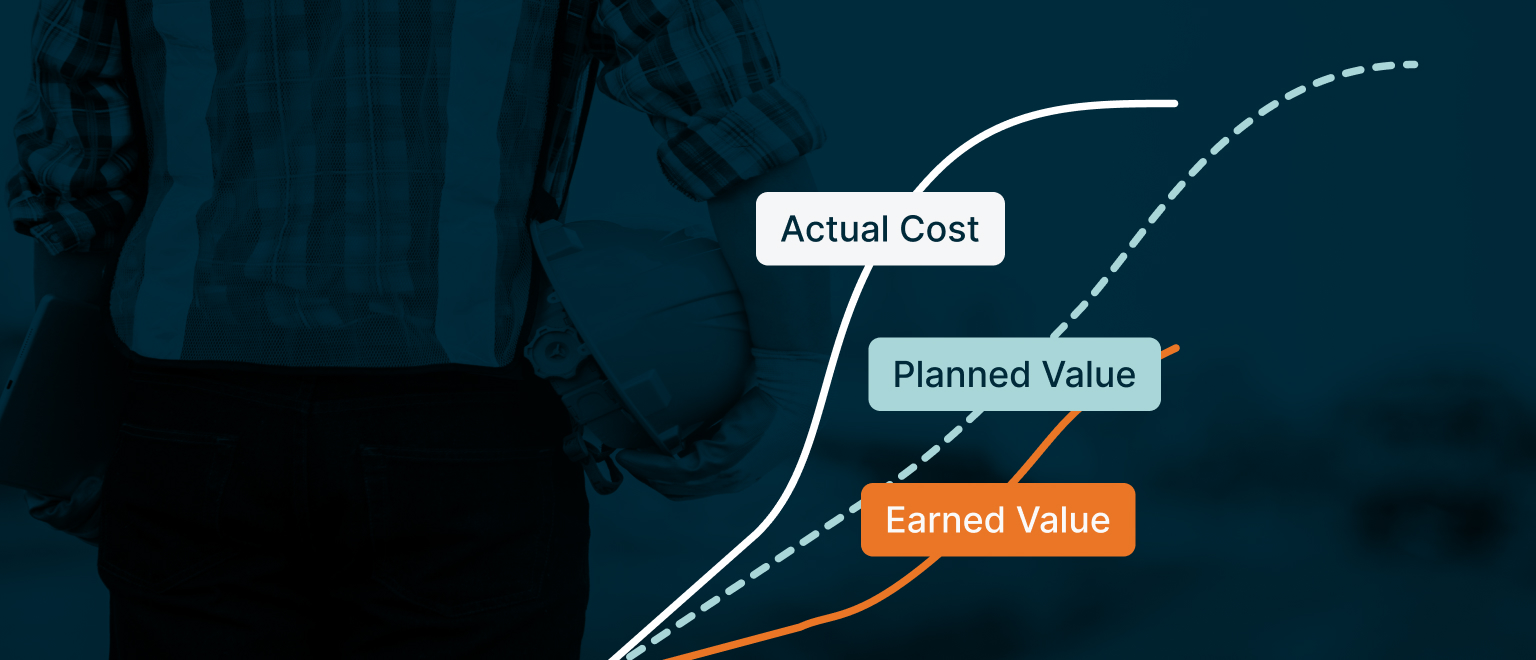
Earned Value Management should tell you three things at any moment:
- Where you planned to be (Planned Value)
- Where you actually are (Earned Value)
- What it cost you to get there (Actual Cost)
When it works, EVM is gold. You spot problems at 20% completion instead of 80%. You know exactly how much profit you’re making (or losing) on every deliverable.
By combining scope, schedule, and cost data into unified metrics like Cost Performance Index (CPI) and Estimate at Completion (EAC), you can forecast final costs while there’s still time to course-correct.
For heavy construction and utility work where margins are tight and delays cost real money, this kind of visibility is the difference between profit and loss.
Research shows that organizations using EVM deliver projects closer to budget and on schedule. The method provides early warning signals. For instance, a CPI below 1.0 means you’re over budget for the work completed, while trending analysis can predict final costs when a project is only 15-20% complete.*
So, why doesn’t anyone actually use it?
The Data Collection Barrier
Because EVM requires something most construction firms can’t deliver: real-time data from the field.
To make EVM work the traditional way, you need to:
- Track every quantity completed in the field (linear feet, cubic yards, pole installations)
- Match labor hours to specific work activities
- Allocate materials and equipment costs to the right deliverables
- Reconcile timecards, purchase orders, and change orders
- Update progress percentages based on actual work completed
- Keep all of this aligned between what you planned and what actually happened
And here’s where it falls apart.
Most construction firms face an impossible choice: hire someone full-time to track down numbers and fix spreadsheets, or give up the tracking altogether.
Project managers end up working with outdated information, making million-dollar decisions based on data that’s weeks old.
By the time you know you’re in trouble, you’re deep in it.

How much are your field operations costing you?
How Aimsio Solves the Data Problem
We didn’t solve this by making EVM simpler. We solved it by eliminating the data collection barrier entirely, and by doing all the complex calculations in the background.
Here’s how it works:
Crews Enter Data Once. Everyone Uses It.
Rather than creating extra steps, Aimsio captures data from processes that are already happening.
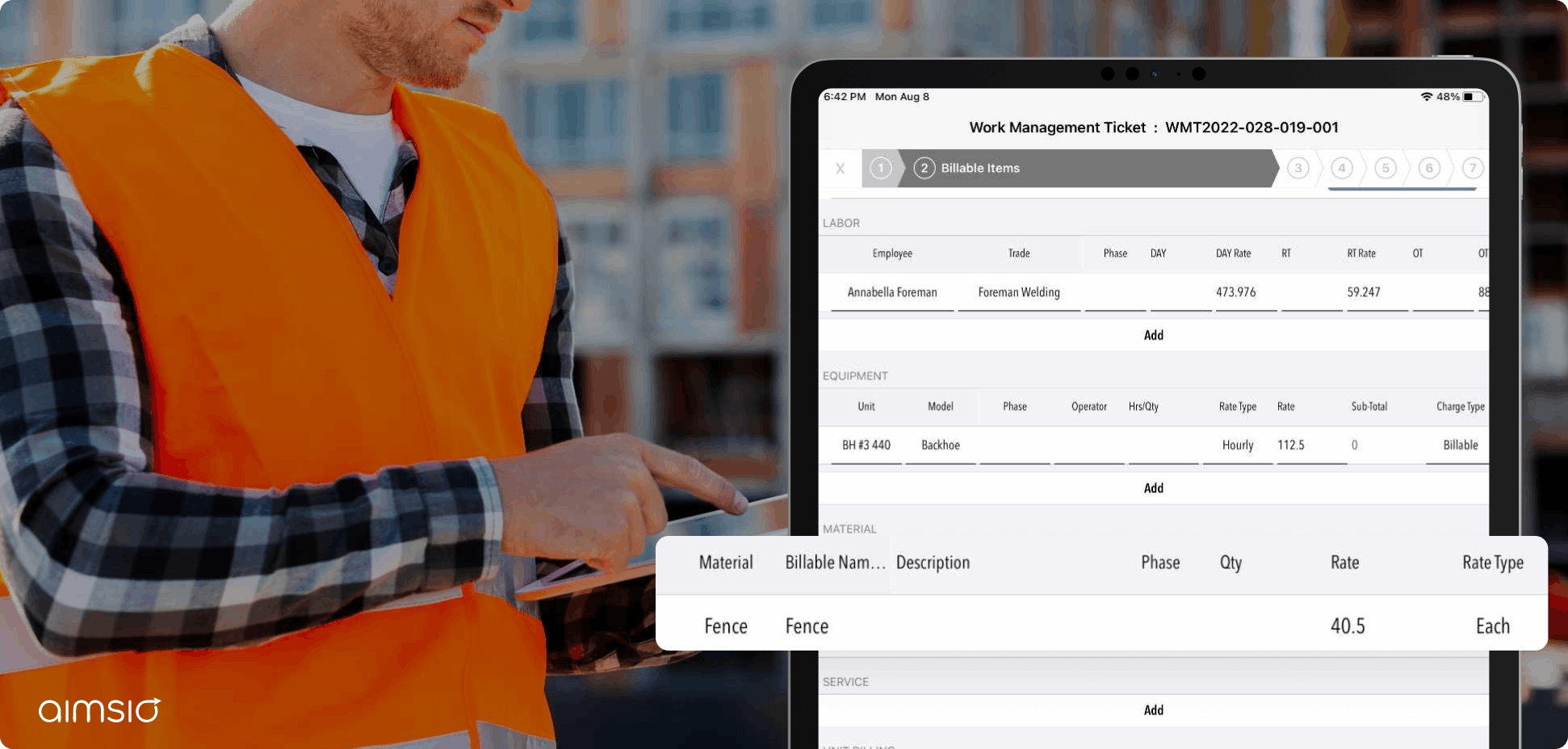
When field crews fill out their timesheets or tickets, they’re simultaneously recording physical progress against specific activities.
A superintendent marks that 150 feet of pipe went into the ground? That quantity automatically updates your deliverable’s completion percentage. It flows through your earned value calculations. It updates your budget tracking. It shows up on your dashboard.
No duplicate data entry. No wondering if numbers are up-to-date.
Every Cost Gets Tagged Automatically.
One of the most time-consuming aspects of traditional EVM is ensuring every cost gets allocated to the right work package.
As labor hours, materials, and equipment usage are recorded, they’re immediately linked to WBS activities. Your timecard gets submitted? Those costs are immediately reflected in your actual spend against that deliverable.
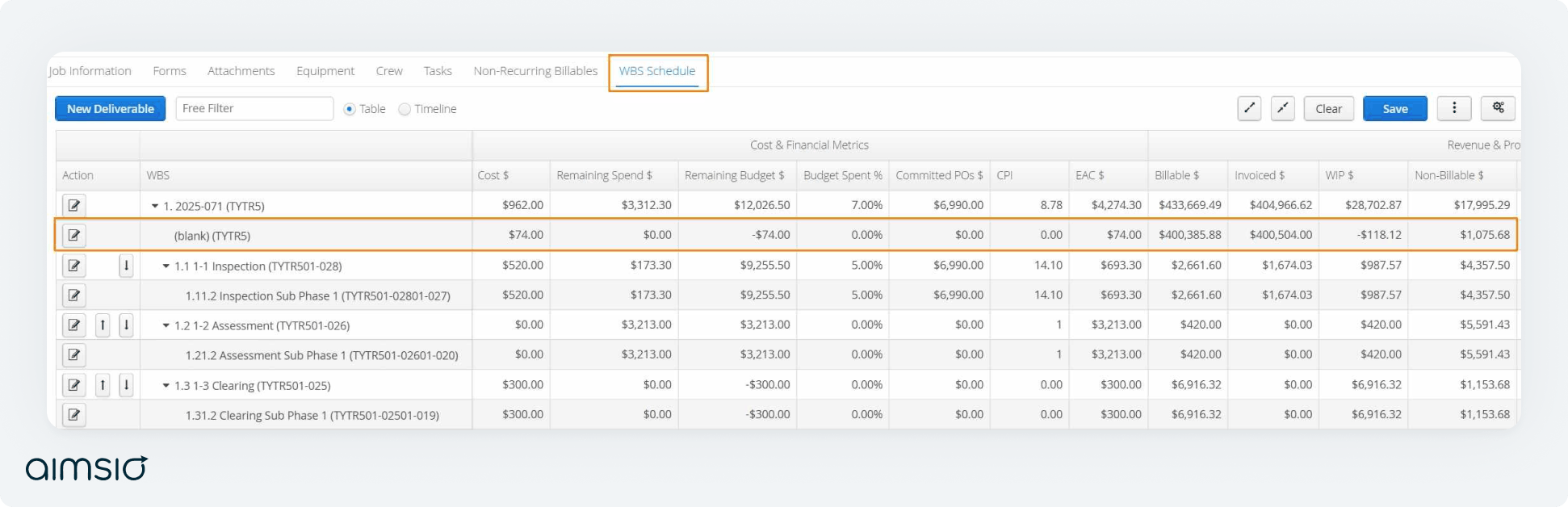
For anything that didn’t get assigned initially, Aimsio surfaces it in a dedicated “(blank)” row. You can see unallocated hours or costs in one place and assign them to the correct activity–even retroactively for closed pay-periods.
Numbers Update in Real-Time.
Your Cost Performance Index, Estimate at Completion, and Budget Variance are all live. As work happens, your metrics update. No waiting for month-end reports or manual spreadsheet consolidation.
The system tracks your forecast two ways: assume things stay the same (trend-based), or you can adjust it based on changes you see coming (performance-adjusted). Either way, you get an instant answer to “how much profit am I making on this job right now?” in seconds, not days.
Budgets and Changes Stay Connected.
Earned Value only works when it’s measured against a well-structured baseline.
Aimsio lets you build budgets however you want: simple job totals, detailed breakdowns by labour and equipment, or full budgets that include regular time, overtime, and equipment costs.
When change orders get approved, your baseline budget and contract values update automatically. You’re always measuring against the current scope, not some outdated estimate from six months ago.
Physical Progress Reflects Reality.
Here’s where most systems fail: they track money spent, not work completed. Spending money doesn’t mean you’re making progress.
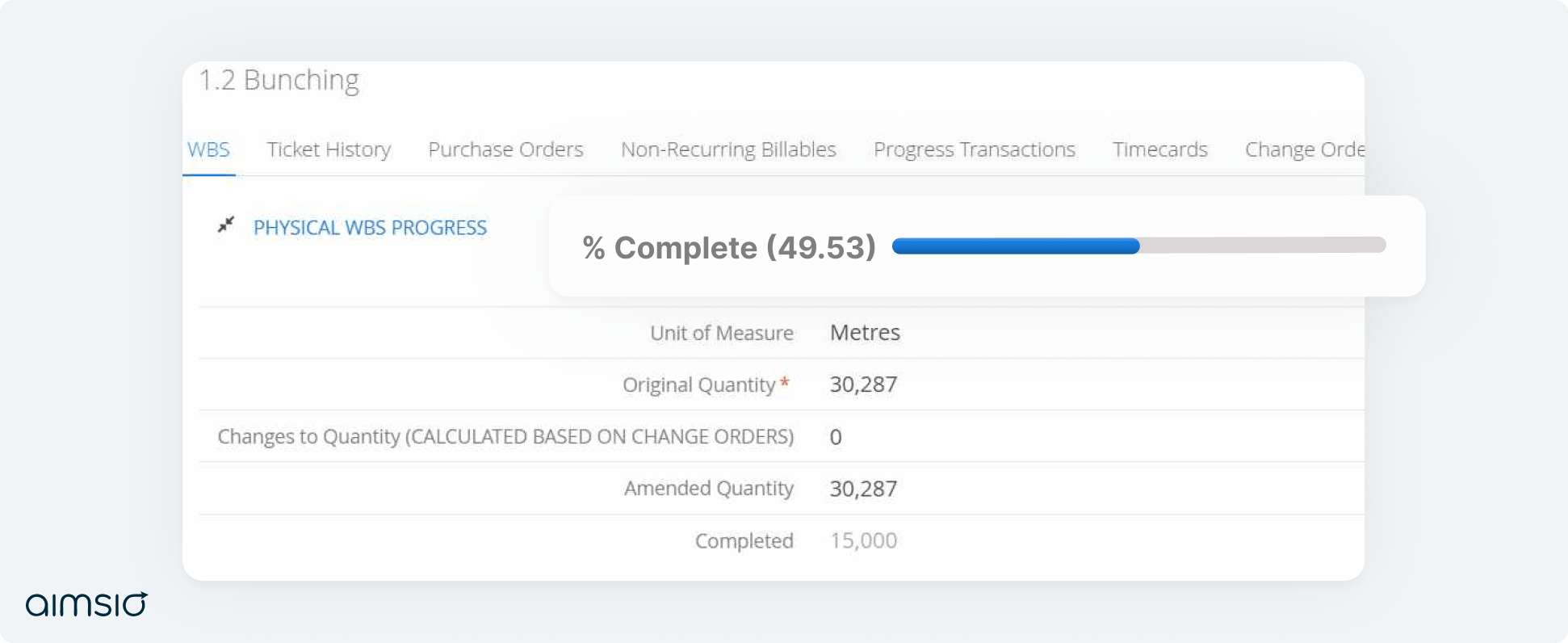
Aimsio measures progress in units that matter for your work: linear feet of pipe, cubic yards of concrete, or number of poles installed. Your crews record actual quantities as part of their normal workflow.
The system keeps a complete record of when progress was logged and by whom. You’ve got an audit trail. Your percentage-complete calculations reflect actual field conditions, not assumptions.
The Result: Proactive Project Management
When your data updates automatically, you stop wasting time collecting information and start using it.
You notice the CPI dropping on a specific deliverable. You click in and see exactly which timecards and costs are causing the problem. Is it slow productivity? Scope creep? A bad estimate? You can fix it while there’s still time.
When a customer asks about a change order, you can model how it affects your budget and schedule in minutes. You use real data from similar work already completed.
Your executive team gets the numbers they need without drowning your teams in paperwork. The same data crews enter for payroll automatically generates the metrics your CFO needs to assess project health.
From the field to finance. One platform. No gaps.
Making EVM Practical for Construction
The construction industry has known about EVM’s benefits for decades. What’s been missing? A way to make it work without drowning in data entry.
Aimsio removes the barriers that kept EVM stuck in spreadsheets and monthly reports. Physical progress tracking, financial management, and work breakdown scheduling–all in one platform.
Your crews are doing the work. Your office needs the numbers. Aimsio makes sure nothing gets lost in between.
Because when you’re managing millions in projects across remote sites, “close enough” isn’t good enough.
See how Aimsio turns field chaos into financial clarity without adding headcount or slowing down your crews.

Aimsio is the all-in-one field-first, back-office-ready platform that helps commercial and industrial companies digitize their operations, eliminate paperwork, assign crews, track progress, and invoice with precision. From the oilfields to the interstate, we help field teams and finance teams perform with clarity, visibility, and confidence.
Field-First. Back Office-Ready. Transforming the Field.