Aimsio Team
If your back office runs on Sage Intacct, you already have enterprise-grade financial infrastructure. What Sage Intacct wasn’t built for is what happens before an invoice exists: the field ticket, the crew hours, the equipment log, the approval chain that connects a day’s work to a billable document.
That gap costs commercial and industrial companies 3 to 7% of revenue annually in billing delays, missed billables, and manual reconciliation errors. And it doesn’t close itself. If you’re still deciding whether field service management software belongs in your stack at all, start with our ERP vs. FSM breakdown. If Sage Intacct is already your financial backbone and you’re looking to connect it to your field operations, here’s how Aimsio does that.
Aimsio is a field service management platform built for oil and gas, construction, utilities, and related sectors. It captures work as it happens in the field, routes it through approvals, and pushes clean, verified invoices directly into Sage Intacct. Your finance team stops chasing field data. Your Sage environment gets structured inputs. And the billing cycle shortens from weeks to days.
This article covers how the integration works, what data flows between the two platforms, and why companies running complex financial operations are pairing enterprise accounting with field-first execution software.
Are Aimsio and Sage Intacct Complementary or Competing Products?
This is worth addressing head-on, because the question comes up.
Sage Intacct is an enterprise financial management platform. It handles multi-entity consolidation, dimensional reporting, revenue recognition, and compliance. It’s a system of record, designed to capture what happened financially.
Aimsio is a system of execution. It controls how revenue gets captured in the first place: field tickets logged in real time, approvals routed digitally, invoices built from verified data before anything reaches your accounting environment.
They solve different problems. And when they’re connected, they solve those problems together.
| Capability | Sage Intacct | Aimsio | Working Together |
|---|---|---|---|
| Multi-entity financial consolidation | Yes | No | Aimsio feeds clean, structured data into Sage’s multi-entity framework |
| Real-time field ticket capture | No | Yes | Work is captured at the source, not reconstructed after the fact |
| Dispatch and crew coordination | No | Yes | Aimsio manages the field; Sage records the financial outcome |
| Client-facing invoice approval workflow | No | Yes | Aimsio handles approvals before data ever reaches Sage |
| GAAP-compliant financial reporting | Yes | No | Sage produces the reports; Aimsio ensures the underlying data is complete |
| Offline mobile data capture | No | Yes | Field crews log hours in areas without connectivity; data syncs when service returns |
| Job costing in real time | No | Yes | Aimsio surfaces cost vs. actual while the project is still running |
| AR/AP processing and banking integration | Yes | No | Invoices arrive in Sage clean, approved, and ready to post |
The short version: Sage Intacct knows what your business did financially. Aimsio controls how that revenue gets captured in the first place.
What Does the Aimsio and Sage Intacct Integration Include?
The integration connects two systems that were each designed for their own domain, and makes the data handoff between them automatic.
Here’s what flows between platforms.
From Sage Intacct into Aimsio (imports):
Aimsio pulls the following records from your Sage environment to use as master data:
- Customers (imported as Companies (Client) in Aimsio)
- Vendors (imported as Companies (Vendor) companies or Employees (Subcontractor), depending on your configuration)
- Employees
- Projects
- Items (imported as Service Billable Items by default, with the ability to configure for equipment, labor, or other types)
Imports can be scheduled to run automatically each morning at 5AM MST, or triggered manually when needed. Sage Intacct is treated as the source of truth: if a record is updated in Sage and re-imported, it will overwrite any changes made to that record directly in Aimsio. Make changes in Sage first, then let the import carry them across.
From Aimsio into Sage Intacct (exports):
Once field work is captured, approved, and invoiced in Aimsio, the following records can be pushed to Sage:
- Jobs (mapped to Projects in Sage)
- Work Breakdown Structure activities (mapped to Tasks, with status updates supported after the initial export)
- Invoices (pushed as Invoices or Sales Order entries)
- Timecards (pushed to Sage’s Time and Expenses module)
- Purchase Orders
- Non-recurring Billables
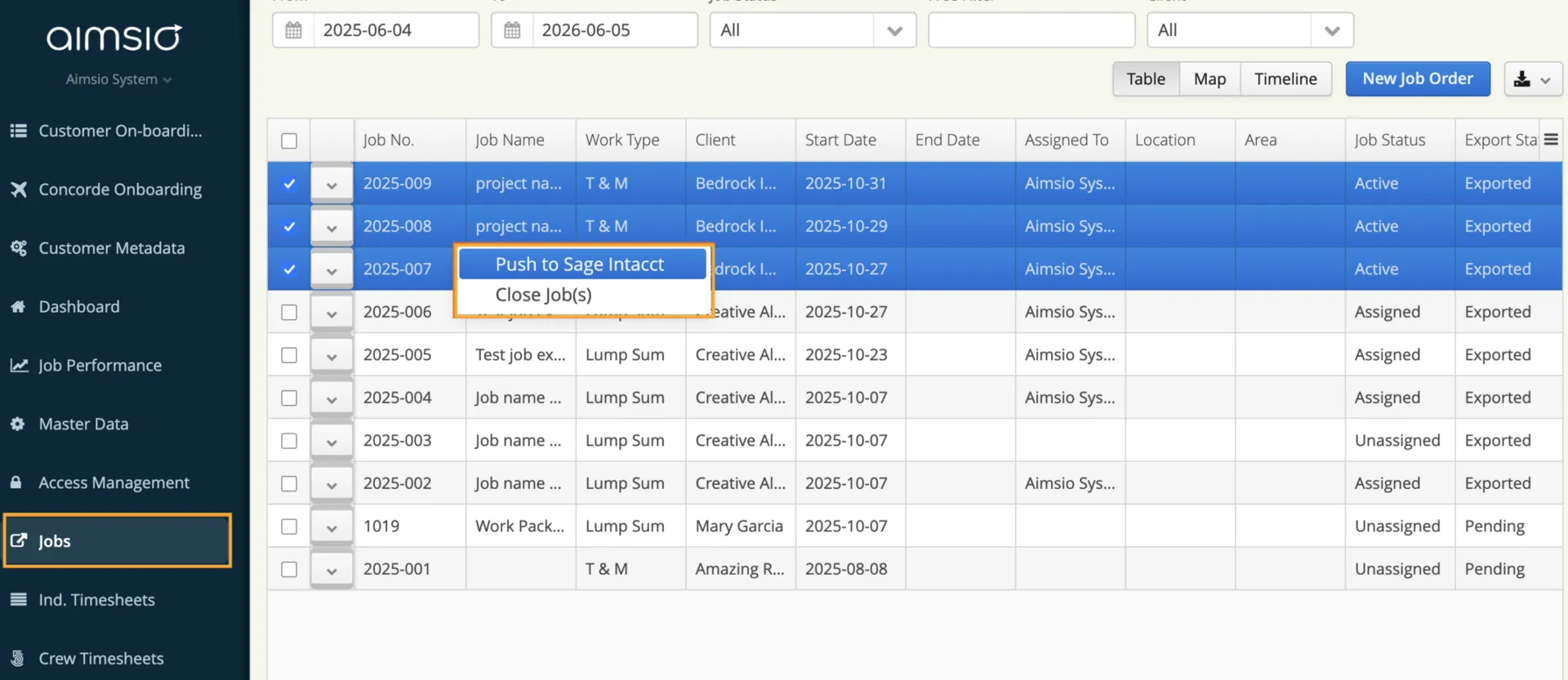
Records can be pushed individually or all at once. Once they’ve been successfully sent, each record updates to an “Exported” status so your finance team always knows what’s made it to Sage and what’s still pending. And the integration doesn’t stop at the initial push. As work progresses in Aimsio, status updates like job completions carry through to the corresponding records in Sage automatically. Your accounting environment stays current without anyone manually syncing the two systems.
How Do You Set Up the Aimsio and Sage Intacct Integration?
Setup involves a short technical handshake between your Sage environment and Aimsio’s system, and the Aimsio team handles the heavy lifting on their side.
Here’s what you’ll need to do in Sage Intacct:
- Enable Web Services in your Sage account (Company → Subscriptions → Web Services)
- Add Aimsio’s sender ID to your account’s allowed list: aimsioMPP
- Create a dedicated Web Services user for Aimsio with role-based permissions covering accounts payable, accounts receivable, projects, items, employees, and time and expenses
- Provide Aimsio with your Web Services sender ID and password
From there, the Aimsio team connects the accounts on their end. Once live, authorized users in your organization access all integration options directly from the Integrations page in Aimsio’s sidebar.
There’s no middleware to manage and no complex API configuration on your end.
Walk through the full setup guide here.
Which Field Service Companies Should Use Aimsio with Sage Intacct?
If you’re running Sage Intacct, you likely have multi-entity structures, complex revenue recognition requirements, or reporting needs that go beyond what lighter accounting tools can handle. You’ve invested in enterprise finance infrastructure because your financial complexity demands it.
But financial complexity and field complexity are two different problems. And the gap between your Sage environment and your field operations doesn’t close because your accounting system is sophisticated.
Crews still capture work on paper or in disconnected apps. Billing coordinators still reconcile manually. Invoices wait on approvals that should have happened days ago. Aimsio is built for exactly this: the conditions of industrial field work, including offline environments, dispersed crews, high-volume ticket processing, and the need to capture every billable hour, piece of equipment, and material cost at the moment work happens.
Companies running Aimsio alongside Sage Intacct tend to share a few characteristics. They’re operating at a scale where billing errors and delays have material financial consequences. They’ve tried to solve the field data problem with spreadsheets or workarounds and hit a ceiling. And they need their back office to reflect what’s actually happening in the field, not a version of it that arrives two weeks late.
What Changes When the Two Systems Are Connected?
Here’s what the workflow looks like after integration:
Your finance team stops re-entering data. Master records from Sage, including customers, projects, employees, and vendors, are already in Aimsio before a job starts. Field crews log labor, equipment, and materials in real time from their phones. Project managers see cost versus budget as it moves, not after the project closes.
When work is done, tickets move through internal approval in Aimsio. Your operations team reviews first. Clients sign off digitally through Aimsio’s client portal. No email chains, no PDF exports, no phone calls chasing signatures.
Finance builds the invoice from approved tickets, with billing rules already configured in the system. The invoice goes out the same day work is completed. Then it’s pushed to Sage Intacct in bulk or individually, landing in your AR workflow with its status marked “Exported.” Your books reflect the real number.
The shift isn’t incremental. Your ops manager stops being the person who chases field data. Your controller stops reconciling manually. Your billing cycle runs in days, not weeks. And your Sage Intacct environment finally has the clean inputs it was designed to work with.
Aimsio has processed over 6.5 million field tickets and more than $11 billion in invoices across energy, construction, and utility sectors. That’s not pilot volume. That’s live transaction flow in the same operating environments your crews work in every day.
Why Field Companies Pair Aimsio with Sage Intacct
Sage Intacct and Aimsio aren’t solving for the same problem. That’s the point.
Sage Intacct handles the financial complexity that enterprise-level field companies need. Aimsio handles what comes before: capturing work at the source, routing it through approvals, and delivering verified data to your accounting environment before the billing window closes.
Together, they close the field-to-finance gap that costs commercial and industrial companies 3 to 7% of revenue annually. Not through better dashboards or more reporting. Through structural change in how revenue gets captured in the first place.
If your back office runs on Sage Intacct and your field operations are still running on paper, spreadsheets, or disconnected tools, the integration is worth a close look.
See how Aimsio connects to Sage Intacct in your environment. Book a 30 minute demo and we’ll walk through:
- Where your current field-to-finance process is losing revenue
- How Aimsio captures billable work at the source before it slips through the cracks
- The approval workflow from field ticket to client sign-off
- How invoices push from Aimsio into your Sage Intacct environment
- What the full integration looks like for your specific operation
Talk to someone who knows field ops →
Frequently Asked Questions
Does Aimsio replace Sage Intacct?
No. Aimsio and Sage Intacct are built for different parts of the operation. Sage Intacct handles enterprise financial management: multi-entity consolidation, revenue recognition, compliance, and reporting. Aimsio handles field execution: ticket capture, crew dispatch, approvals, and invoice creation. The integration connects the two so clean, verified data flows from the field into your accounting system without manual re-entry. For a deeper look at how field service management software and accounting systems divide responsibilities, see our full ERP vs. FSM comparison.
What data can Aimsio import from Sage Intacct?
Aimsio imports Customers, Vendors, Employees, Projects, and Items from Sage. Imports can be scheduled to run automatically each morning or triggered manually. Sage Intacct is treated as the master source, so a re-import will overwrite any changes made directly in Aimsio.
What can Aimsio push to Sage Intacct?
Aimsio can export Jobs, Work Breakdown Structure activities, Invoices, Timecards, Purchase Orders, and Non-recurring Billables to Sage Intacct. Records can be pushed individually or in bulk, and Jobs and WBS activities support status updates after the initial export.
What if our field crews don't have cell service?
Aimsio is built for offline environments. Crews capture tickets, hours, and materials without connectivity, and data syncs automatically when service returns. This is one of the core reasons industrial companies in remote oilfield and construction environments choose Aimsio over office-first tools.
Is this integration suitable for companies with complex billing rules?
Yes. Aimsio supports configured billing rules including prevailing wage calculations, union rates, and client-specific billing requirements. These are applied at the invoice creation stage in Aimsio, before the invoice is pushed to Sage Intacct. Your finance team isn't doing manual math or spreadsheet adjustments after the fact.
How is Aimsio different from just using Sage Intacct's project management features?
Sage Intacct's project accounting tools are designed for financial oversight: tracking costs, managing budgets, and reporting on project health from the office. Aimsio is designed for field execution: dispatching crews, capturing tickets offline, routing client approvals, and creating invoices from verified field data in real time. The two cover different parts of the operation, which is why they work better together than either does alone.
Can Aimsio work with Sage Intacct and another accounting system at the same time?
Aimsio supports integrations with various accounting and ERP platforms, including QuickBooks Online, Sage 300, NetSuite, and others. If your organization uses more than one financial system, contact Aimsio to discuss how data flows can be configured for your specific setup.